Have you ever looked at your calendar, your spending, or your daily habits and thought…
“This doesn’t actually reflect the life I want.”
You’re not alone.
So many of us are stuck on autopilot—doing what we’re “supposed” to do, checking the boxes, meeting expectations, and keeping up with a pace that leaves no room for clarity. But deep down, you might be craving more.
Not just getting through your days…
But designing them—intentionally, purposefully, in a way that reflects what really matters to you.
If you’ve been wondering how to live a values-based life, this post is your starting point.
What Does It Really Mean to Live in Alignment?
Living in alignment—or living a values-based life—means your actions, habits, and decisions reflect your personal values. You’re no longer just reacting to the chaos or chasing someone else’s version of success. Instead, you’re building a life that’s grounded in clarity and intention.
When you live in alignment:
- Your time is spent on what energizes and fulfills you
- Your money supports your true goals and priorities
- Your habits move you toward the life you want
- Your mindset feels grounded and empowered
- Your life starts to feel like yours again
This doesn’t require perfection or having it all figured out. It simply requires awareness and tiny aligned choices—taken one day at a time.
The Problem with Autopilot Living
If you’ve ever caught yourself saying:
- “I’m busy all day but feel like I got nothing meaningful done.”
- “I want to save money but keep impulse spending.”
- “I don’t even know what I want anymore… I’m just surviving.”
You’re not broken.
You’re just out of alignment.
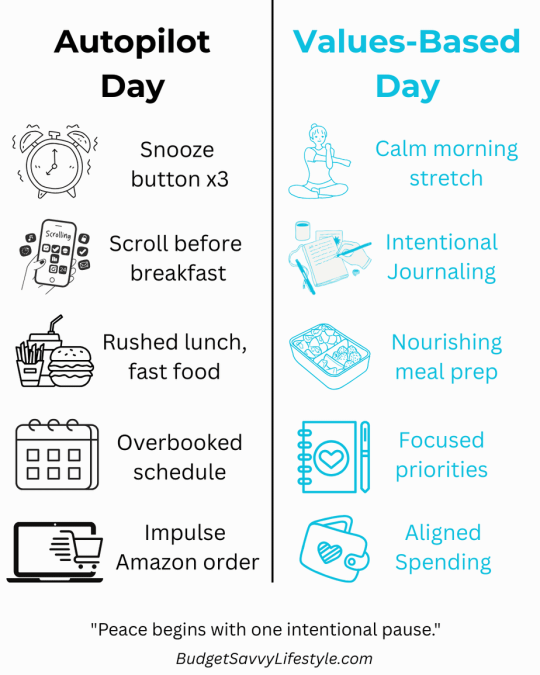
Autopilot living is common, especially during seasons of overwhelm, transition, or even outward success. When you’re in it, your days are full—but your soul feels empty. Your schedule is packed—but your values are buried.
You may find yourself:
- Drifting into habits that don’t serve you
- Feeling disconnected from your purpose
- Spending time and money on things that don’t actually matter to you
- Saying “yes” to everything and everyone—except yourself
The good news? Alignment is always possible. It starts with getting clear.
Step One: Clarify What Matters Most
Before you can create a life that reflects your values, you have to define what those values are. Clarity gives you a compass. Without it, it’s easy to get swept up in what everyone else is doing.
Try these 3 simple exercises:
1. Name your top 3 values
Ask yourself: What matters most to me right now?
Write down three words that reflect your values today.
Examples: Peace. Flexibility. Family. Purpose. Simplicity. Creativity. Health.
This list will change over time—but naming it today gives you a starting point.
2. Describe your dream day
Imagine a day that feels calm, fulfilling, and energizing.
What would you do? What wouldn’t you do?
How would your morning feel? Your evening? What would be different from today?
This vision helps you uncover your values in action.
3. Pinpoint one area that feels “off”
Where do you feel guilt, resistance, stress, or disconnection?
That area is probably misaligned. Maybe you’re overspending, overcommitting, or just running on empty. That’s where your next small shift can begin.
Step 2: Audit Your Current Life
Awareness is the first step to change—and it starts with an honest look at how you’re living now.
Before you can create a life that reflects your values, you need to understand where you’re currently out of alignment. This step isn’t about judgment—it’s about curiosity. You’re simply gathering clues about what’s working and what’s not.
Use this audit to explore how your time, money, energy, and routines are being spent—and whether those choices reflect what matters most to you.
🗓️ Review Your Weekly Calendar
Look at how you spent your time over the past 7 days. Where did your hours go?
Ask yourself:
What filled my days—work, errands, scrolling, caregiving?
Did I schedule time for things that restore me?
Which activities energized me—and which ones drained me?
Am I overcommitted in ways that pull me away from my values?
Highlight what felt aligned (a peaceful morning, a family dinner, a walk in nature). Circle what felt misaligned (meetings that could’ve been emails, constant multitasking, zero alone time).
This reveals where your time and values do or don’t match up.
💸 Track Your Spending for 7 Days
Money is one of the clearest indicators of what you’re prioritizing—consciously or not.
Spend a week writing down everything you spend. Then reflect:
Which purchases felt aligned with my values (e.g. nourishing groceries, a donation, a tool that made life easier)?
Which felt impulsive, wasteful, or emotionally driven?
Are there patterns in how I spend when I’m stressed, bored, or overwhelmed?
You don’t need to restrict—just observe. This will help you create a budget that reflects what really matters to you.
🔁 Observe Your Energy + Daily Routines
Your body and mood are powerful feedback tools.
Ask yourself:
When do I feel most like myself?
Which parts of my day feel rushed, tense, or chaotic?
What habits ground me—and what ones derail me?
Do I wake up with intention—or immediately react to the day?
Take note of:
Sleep routines
Screen time habits
How often you move your body
What you eat and drink
Your mindset and self-talk
These small things shape the way you feel—and often signal where you’re out of sync with your deeper needs.
📝 Bonus: Check Your Commitments
List out your current obligations—work, family, volunteering, side projects, social plans.
For each one, ask:
Does this support my values?
Do I genuinely want to do this—or am I people-pleasing?
Is this the right season for this commitment?
It’s okay to lovingly release things that no longer fit your life.
💡 Pro Tip: Don’t Try to Change It All Right Away
You’re not auditing your life so you can overhaul it tomorrow.
You’re doing this so you can take aligned action—intentionally and one step at a time.
This awareness helps you identify one small shift to make in Step 3.
Step Three: Make One Small Shift
Trying to overhaul your whole life overnight is overwhelming and unsustainable. That’s not what alignment is about.
Living a values-based life happens through micro-moves.
Here are small, aligned shifts you could try:
Time
- Protect your mornings for a quiet routine
- Add white space to your calendar
- Create a weekly rhythm to bring stability
Money
- Track your spending and notice what feels aligned
- Cut expenses that don’t bring value
- Save for things that actually light you up
Mindset
- Replace all-or-nothing thinking with “progress over perfection”
- Reframe limiting beliefs (like “I never follow through”)
- Practice gratitude for what’s already aligned
Habits
- Add a 5-minute intentional ritual to your day
- Stack a habit onto something you already do (habit stacking!)
- Choose one new action that reflects your values—and repeat it
These shifts are simple. But over time, they create a life that feels aligned—not just looks productive.
Step 4: Create Supportive Systems
Once you’re clear on what matters, it’s time to build structure around it.
Creating a values-based life isn’t about discipline—it’s about design. Systems help you protect what’s important, reduce decision fatigue, and stay aligned when life gets full or messy (because it will!).
Supportive systems are rhythms, routines, and tools that take your values from ideas to action. They make your days feel lighter and more intentional—not more rigid or demanding.
Think of them as anchors that support your aligned life behind the scenes.
📅 Weekly Planning That Reflects Your Values
Instead of starting your week with a to-do list, start with your top 3 values. Ask:
What matters most this week?
How can I protect time for that—on purpose?
Where do I need to say no so I can say yes to what fills me?
Then build your schedule around what matters—not just what’s urgent. For example:
If family is a core value, block off unhurried dinner times.
If growth is a priority, schedule reading or course time.
If peace is what you need, leave margin for rest or creative flow.
💡 Tip: Create a weekly reset ritual (like on Sundays) to reflect, plan, and realign. This keeps your values front and center.
💰 Budget Systems That Reflect Your Real Goals
Money stress often stems from misalignment—not just lack.
When your budget reflects your values, you feel more in control and less restricted. Try this:
Label your spending categories by goal or feeling (e.g. Joyful Giving, Health & Nourishment, Peaceful Home)
Track your spending not just by amount, but by alignment
Build a habit of checking in weekly with your money—not just monthly
This turns budgeting into a tool of empowerment instead of anxiety. You’re telling your money where to go—based on what matters most.
🍳 Routines That Reduce Stress (and Reflect Your Season)
Stress doesn’t always come from doing too much—it often comes from deciding too much.
Routines minimize decisions while maximizing peace and energy.
Here are a few value-aligned routines to try:
Morning routine that sets the tone for your day (e.g. stretch, journal, read a quote, set intentions)
Meal planning system that saves money and supports your health goals (e.g. theme nights or ingredient prep)
Evening wind-down ritual that helps you reconnect and reflect (e.g. tea, gratitude list, screen-free hour)
Home care rhythm that keeps your space supportive (e.g. a 10-minute reset each night or a weekly “house cleaning power hour”)
The key is not complexity—it’s consistency. Start with one simple habit, and let it become a supportive rhythm.
🔄 Automate or Simplify What Drains You
Alignment isn’t just about adding more of the good—it’s also about removing the things that drain your energy and decision-making power.
Ask:
What can I automate? (e.g. bill payments, grocery list templates, recurring routines)
What can I simplify? (e.g. meal planning, wardrobe, inbox filters)
What can I delegate or release?
Even small tweaks (like batching errands or creating a default grocery list) can free up mental space for the things that matter most.
💡 System-Building Doesn’t Have to Be Perfect
Don’t wait until you’ve found the perfect planner, ideal routine, or best app.
Start with a simple question:
“What system would make this area of my life easier—and more aligned with my values?”
Then try one small experiment. Build slowly. Tweak often. Let your systems support your season, not some fantasy version of your life.
Step 5: Revisit and Realign Regularly
Living a values-based life is a rhythm—not a one-time reset.
Alignment isn’t something you “set and forget.” It’s a living, breathing practice—one that shifts as your life, priorities, and seasons evolve. What felt aligned last year (or even last month) may not feel aligned today—and that’s okay.
That’s why making space to pause and reflect is essential. These intentional check-ins allow you to course-correct before burnout, realign when you feel off, and celebrate the small shifts you’re already making.
🗓️ Create a Monthly Alignment Check-In
Think of this as your personal reset ritual—a gentle time to reflect, adjust, and move forward with intention.
Here’s a simple framework you can use each month:
1. Reconnect with Your Values
Ask:
Do my top 3 values still feel true this month?
Have any new priorities or desires emerged?
Is my life structured around these values—or drifting from them?
Remember, your values might evolve over time. What matters is that you keep asking the question.
2. Review What’s Working (and What’s Not)
Look back at your routines, systems, habits, and choices.
Consider:
Where did I feel most like myself this month?
What drained me or pulled me out of alignment?
What patterns, commitments, or beliefs no longer serve me?
This reflection helps you gently release what’s no longer a fit—and keep what supports your well-being.
3. Celebrate Small Wins
Living with intention doesn’t mean perfection—it means awareness and progress. Acknowledge the aligned choices you did make:
Saying no to something that felt off
Starting a new habit that reflects your values
Protecting time for what you love
Being more mindful with your money
Pausing before reacting out of habit
Even the tiniest shift deserves celebration. These micro-moments of alignment compound over time.
4. Choose One Area to Realign
You don’t need to fix everything. Choose one focus for the upcoming month:
Do you want to feel more peace in your mornings?
More intention in how you spend money?
More presence in your relationships?
Pick a small, specific action—like a new boundary, a simplified routine, or a reflective journaling habit—that supports that intention.
💡 Keep it doable, gentle, and rooted in what matters most to you right now.
🌿 Bonus: Use Rituals to Anchor Your Realignment
Turn your check-ins into a calming ritual you look forward to:
Light a candle, make tea, or play soft music
Use a printable journal page or values check-in worksheet
Pair it with your monthly planning or Sunday reset routine
Reflect, release, and recommit—with self-compassion
✨ Alignment isn’t about perfection. It’s about presence.
Every time you realign—even a little—you’re building a life that reflects who you truly are.
Why It’s Worth It
When you live a values-based life, everything changes:
✨ You no longer feel like you’re constantly behind
✨ You spend your money more intentionally—without guilt
✨ You protect your energy, boundaries, and joy
✨ You make decisions with clarity and confidence
✨ You feel more like yourself, even in busy seasons
And most importantly—you stop waiting for the “perfect time” to live the life you want.
You start building it now, one intentional day at a time.
You Deserve a Life That Reflects What Matters
You don’t need to be more disciplined.
You don’t need another productivity hack.
You need a system that helps you live on purpose.
You need support that honors your season—not your to-do list.
You need space to remember what you truly want—and tools to act on it.
So start here:
✅ Name your values
✅ Dream up your ideal day
✅ Make one tiny shift
Because when your life reflects what matters most—you stop feeling like you’re running in circles…
And start living like the version of you you’re becoming.