
• Skip to primary navigation
  • Skip to main content
  • Skip to primary sidebar
  • Skip to footer
  • Home
  • About Me

Budget Savvy Lifestyle

Create the life of your dreams—on purpose, on budget, and without limits.

  • Deals
  • Food
    • Recipes
    • Meal Planning
    • Aldi Reviews
  • Lifestyle
    • Home Decor
    • Beauty
    • Fashion
    • Parenting Teens
  • Well Being
    • Healthy Eating
    • Fitness
  • Travel
  • Gift Guides

From Dreaming to Doing: Your Roadmap to Stress-Free Travel Planning

July 9, 2025

Let’s Be Honest…

You want to take a trip.
Maybe it’s been on your mind for years.
Maybe it’s just now starting to feel possible.

But the moment you sit down to actually plan it, you get overwhelmed.

Your brain fills with questions like:

  • Where should I go?
  • When’s the best time to travel?
  • What’s the budget?
  • Do I need a visa?
  • How do people even afford to do this?!

Suddenly, you’ve got 14 tabs open, a Pinterest board titled Dream Vacay, 3 half-filled Google Docs, and absolutely zero decisions made.

Sound familiar?

You’re not alone—and you’re not doing it wrong. Planning your dream trip doesn’t have to feel like a second job. You just need a starting point.

A map, some passports and an airplane create this travel scene

The Good News: You Don’t Need to Have It All Figured Out

Stress-free travel planning is possible. You don’t have to book everything in one sitting, have every day scheduled, or feel like a pro.

All you need is a clear, focused beginning—a way to move from “Where do I even start?” to “I’m actually doing this.”

Let’s break it down into five bite-sized steps so you can go from dreamer to traveler—without the overwhelm.

Step 1: Clarify Your “Why”

Before you pick a place, book a flight, or even peek at your budget—pause.

Ask yourself:

  • Why do I want to take this trip?
  • What do I want to feel?
  • What do I want to remember?

Do you want to…

  • Rest and recharge from burnout?
  • Reconnect with your partner or family?
  • Mark a milestone birthday or anniversary?
  • Experience a new culture?
  • Finally prioritize yourself?

Pro Tip: Start a travel journal or note on your phone. Title it: My Dream Trip. At the top, write your “why.” This simple act will anchor you as you move through planning.

Knowing your purpose helps filter out unnecessary decisions and distractions. You’ll stop planning for someone else’s dream trip and start creating your own.

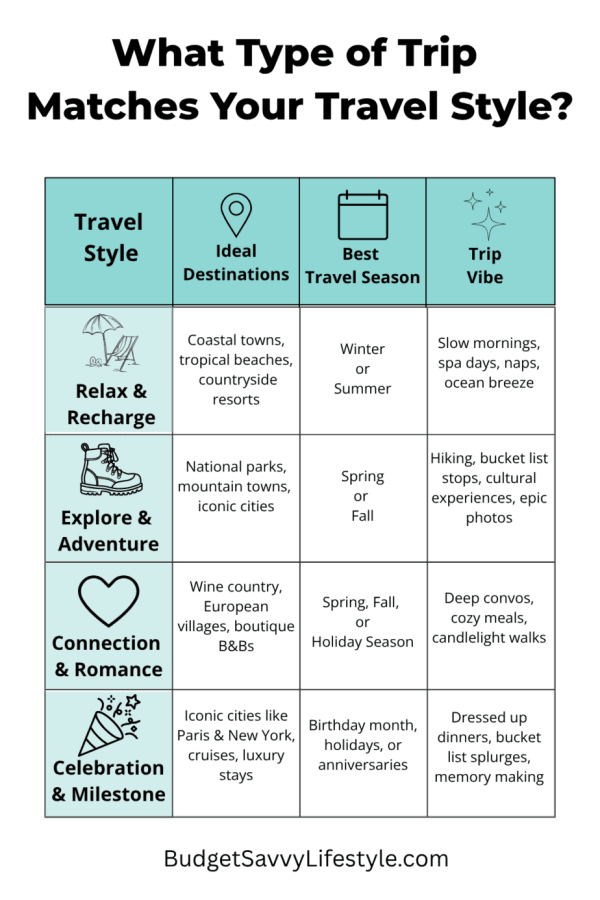
Step 2: Choose Your Travel Style

This is where the magic starts. What kind of traveler are you right now?

Some people want museums and street food. Others want hammocks and ocean waves. There’s no right or wrong—just right for you.

Ask yourself:

  • Am I craving rest or adventure?
  • Do I want city vibes, beach days, or mountain hikes?
  • Am I traveling solo, with my partner, or with kids?
  • Would I rather stay in one place or hop between locations?

Your travel style determines everything: destination, budget, pace, and what’s worth splurging on.

Example:
If you want slow mornings, coffee shops, and local charm, a tiny European village might beat a bustling capital.  If you’re dreaming of awe-inspiring views, maybe it’s time to road trip a national park.

Make a “vibe board” on Pinterest or Canva. Don’t overthink—just collect what feels right. It’s a fun way to visualize your ideal experience and stay aligned as you plan.

What type of trip should I take infographic

Step 3: Know Your (Rough) Budget

Here’s where most people freeze—but don’t worry, this step is more about clarity than math.

You don’t need a perfect spreadsheet yet. You just need a sense of:

  • How much you could realistically save in the next 3–6 months
  • What kind of total trip cost feels comfortable, not stressful
  • Whether you’re flying, road tripping, or staying close to home
  • If traveling in the off-season could help stretch your money

 Write down:

  • “My monthly savings goal: $_____”
  • “My dream budget: $_____”
  • “My max stretch: $_____”

Remember: Budgeting isn’t about limitation. It’s about making the dream doable. Having a number gives you power. You can start filtering destinations, travel dates, and experiences that actually fit your reality.

Step 4: Start Small (and Simple)

Trying to plan everything at once is the quickest way to burn out. Start with just the next step.

Here’s a simplified starter plan:

  1. Write down your travel “why”
  2. Decide what kind of trip you want right now
    (rest, connection, adventure, celebration…)
  3. Brainstorm 2–3 destinations that match your vibe + budget
  4. Pick one destination to explore more deeply

🌟This isn’t about perfection. It’s about momentum. Action builds confidence—and confidence kills overwhelm.
Step 5: Don’t Compare Your Trip to Everyone Else’s

Instagram-worthy itineraries can create serious FOMO—but remember: your trip isn’t a performance.  It’s a personal experience meant to nourish your soul, not your feed.

Stay anchored in your “why,” and let your journey be uniquely yours.

Final Thoughts: You’ve Got This

Planning your dream trip doesn’t have to feel impossible.
Start with clarity. Add simplicity. Stay true to your travel style and budget. And most importantly—don’t rush it.

You’re not behind. You’re exactly where you’re supposed to be.

And now, you have a clear place to begin.

Why You Need a Sunday Reset Routine (& What Happens Without One)

July 8, 2025

Have You Ever Hit Monday Already Feeling Behind?

You open your eyes Monday morning with a groan. The laundry’s still in piles, the fridge is a mess, and your to-do list is nowhere in sight. Before your coffee even kicks in, the week has taken over.

Sound familiar?

It’s not that you’re lazy or disorganized—you’re just running without a rhythm.

When your week starts without clarity, preparation, or even a few moments to breathe, things get chaotic fast. That’s why every busy, budget-savvy woman needs a Sunday reset routine—a small but powerful system that sets the tone for the entire week.

This isn’t about perfection. It’s about peace.

Let’s talk about why your week may feel so overwhelming—and how a Sunday reset can change everything.

A planner, roses and coffee.

5 Reasons You Feel Chaotic by Midweek

1. You Jump Into the Week Without a Plan

When there’s no game plan, you’re in reaction mode all day.
You wake up and immediately ask:
“What am I forgetting?”
“What’s for dinner?”
“Did I RSVP to that thing?”

Without a weekly roadmap, your energy is spent chasing tasks instead of moving through your day with purpose. A Sunday reset routine carves out time to map the week so you can start with intention, not anxiety.


2. You’re Juggling Too Much Without Mental Space

If your kitchen counter is covered in clutter, chances are, your brain feels the same way.
Without a physical and mental “reset,” you spend your days firefighting, not flowing.

A Sunday reset routine helps clear space—literally and figuratively—so you can breathe again. You don’t need a spotless house. Just a tidy enough zone that makes you feel focused and less frazzled.


3. You’re Spending Energy Deciding Instead of Doing

Decision fatigue is real.
Every time you pause to figure out what’s next, you’re draining your mental battery.
What should I make for dinner?
Should I start with email or laundry?
Do I need to run to the store again?

A Sunday reset removes some of those micro-decisions before they even show up. When the basics are decided in advance, you can use your energy for actually living.


4. You’re Ignoring Your Needs

If your reset doesn’t include you, you’ll run on fumes.
Most women plan for everyone else but leave no space for their own rest, joy, or intention. That’s how burnout builds, slowly and silently.

Your Sunday reset is your chance to ask:

  • What do I need this week—emotionally, physically, spiritually?
  • Where can I carve out space for myself?

When you build even 15 minutes for YOU into your week, everything starts to shift.


5. You’re Trying to Plan on the Fly

Let’s be honest—Wednesday night is not the time to figure out goals, dinner, or your energy levels. Midweek is when you need your plan to already be in motion.

When you start the week without a foundation, you waste time trying to pivot constantly. A Sunday reset routine creates a launchpad—one that carries you through the week with less scrambling and more flow.

The Reset Solution: What a Sunday Reset Routine Looks Like

You don’t need an entire day or a Pinterest-perfect planner.
You need a rhythm that works for you.

My personal Sunday reset routine takes about 30–60 minutes. Sometimes I light a candle and make it a vibe. Other times, I’m squeezing it in between laundry loads. The beauty is in the consistency—not the aesthetic.

Here’s what my reset includes:

✅ 1. A Simple Mind-Home-Self Checklist

  • Mind: What’s on my mind? What’s stressing me out?
  • Home: What mess is making me feel unmotivated?
  • Self: What do I need to feel more like me?

Clearing just one thing in each category can instantly shift your energy.

🗓 2. A Quick Glance at the Week Ahead

This is your chance to:

  • Note appointments
  • Time block your priorities
  • Check for any school events, birthdays, or bills due

💡 3. Choose a Weekly Focus Word

Examples: Peace. Momentum. Connection. Nourishment.
Your word anchors you. It keeps you grounded in your why when the week gets noisy.

🎯 4. Set Your Top 3 Priorities

This could be a mix of personal and professional.

  • Finish project X
  • Declutter the pantry
  • Book that dentist appointment

Whatever will move the needle and reduce the noise—those are your “big three.”

🍽 5. Choose a Few Nourishing Meals

No, you don’t need a 21-meal meal plan.
Just choose 2–3 dinners you feel good about. Bonus points if one is a leftover night.
This keeps you from defaulting to takeout or panic-grilled cheese by Thursday.

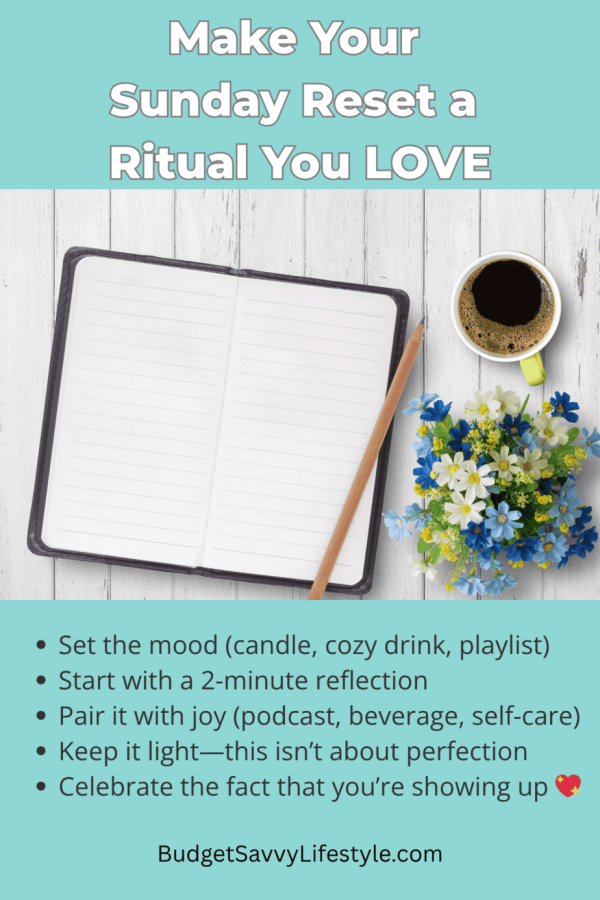
Make It a Ritual—Not a Chore

Let’s be real: the last thing you need is another to-do on your weekend. That’s why your Sunday reset shouldn’t feel like a chore—it should feel like a gift.

Instead of rushing through tasks like you’re prepping for battle, what if your reset felt… calming? Nourishing? Dare we say—delightful?

Here’s how to turn your Sunday reset into a joyful ritual you actually look forward to:


 Set the Mood

Light a candle. Brew your favorite tea. Put on a playlist that makes you feel like you have your life together (even if you’re still in sweats). Creating a sensory atmosphere helps your brain shift from “work mode” to “intentional flow.”


Make It Meaningful

Instead of jumping straight into cleaning and planning, begin with a small reflection:

  • What worked last week?

  • What drained me?

  • What do I want more of this week?

Journaling a few thoughts—even if it’s scribbled on a sticky note—brings mindfulness into your momentum.


Stack It With Something You Love

Pair your reset with something you enjoy:

  • A favorite podcast

  • A cozy snack

  • A facemask while planning your week

  • Having your kids do a “mini-reset” beside you (think: toy tidy-up + choosing clothes for the week)

This creates positive associations and makes it easier to stay consistent.


Keep It Celebratory

This isn’t punishment for being behind—it’s celebration for choosing alignment.

Keep it light, flexible, and grace-filled. You’re not “failing” if you only do part of your routine. Every little reset counts.


Your Sunday reset is a reclaiming of your time, energy, and intentions. When you approach it as a ritual—not a task—you start your week with joy, not just organization.

A planner on a desk with a cup of tea and some flowers.

A Weekly Reset = A Weekly Gift to Yourself

If your week often feels chaotic, you’re not broken.
You just need a system to support you.

The Sunday reset routine is not another chore—it’s a weekly act of self-respect.
When you start your week from a place of calm, clarity, and control, you’re not just surviving. You’re leading your life on purpose.

The Difference Between Cheap and Frugal (And Why It Matters)

July 3, 2025

Let’s Clear Something Up:

Frugal doesn’t mean stingy.
And cheap doesn’t always mean smart.

There’s a big difference between spending less mindlessly and spending less intentionally.

If you’re trying to align your spending with your goals—without sacrificing your values or your self-worth—then it’s time to ditch the “cheap” mindset and embrace true budget-savvy, intentional living.

1. Cheapness Focuses Only on Price—Frugality Focuses on Value

Cheap: Always chooses the lowest price tag, no matter the cost to quality, time, or ethics.
Frugal: Looks for the best value—balancing price, quality, usefulness, and longevity.

Example:
A cheap shopper might buy $10 shoes that fall apart in 2 weeks.
A frugal shopper might spend $40 on shoes that last all year.

Frugal spending is about being smart, not just stingy.

2. Cheapness Often Ignores Impact—Frugality Honors Priorities

Cheap thinking: Cuts corners and avoids investing in what matters.
Frugal thinking: Consciously spends less on what doesn’t matter so there’s more for what does.

Ask yourself:

  • Would I be proud of this purchase a year from now?
  • Am I spending based on fear or purpose?
  • Is this cutting costs or cutting alignment?

3. Cheapness Can Cost You More in the Long Run

It’s ironic—but true.

Trying to “save” money by being cheap can actually lead to:

  • More replacements
  • More frustration
  • Less satisfaction
  • Missed opportunities

Being frugal means spending once, wisely—and freeing up time, energy, and money for the things that count.

4. Frugality Leaves Room for Joy

Cheapness often comes from a scarcity mindset:

“I can’t afford anything.”

Frugality comes from an abundance mindset:

“I choose to spend where it matters most.”

That small but powerful shift allows you to:

  • Save strategically
  • Spend without guilt
  • Say YES to what you love—without blowing your budget

5. Ask Yourself: Am I Being Cheap or Frugal?

Here’s a simple gut check:

If you…

You’re Probably…

Say no to everything—even what you value

Being cheap

Say no to what doesn’t matter so you can say YES to what does

Being frugal

Buy the cheapest version regardless of quality or ethics

Being cheap

Look for deals that stretch your money further on aligned items

Being frugal

Feel guilty every time you spend

Being cheap

Spend confidently when it supports your goals

Being frugal

Let’s Chat!

Have you ever caught yourself being “cheap” when you really wanted to be frugal?
Comment below with your story—or your favorite frugal win 👇

  • « Go to Previous Page
  • Page 1
  • Page 2
  • Page 3
  • Page 4
  • Interim pages omitted …
  • Page 10
  • Go to Next Page »

Primary Sidebar

Welcome!


Hi, I’m Rebecca—a blogger and budget-savvy wife and mom who loves helping women live intentionally without overspending.
Read more →

Blog Mission Statement

Helping women create the life of their dreams—on purpose, on budget, and one simple step at a time.

Through intentional habits, budget-savvy choices, and doable daily systems, I’ll help you take control of your time, money, and mindset. Let’s make real change feel totally possible.

Recent Posts

  • The Spending Audit: How to Find & Cut Wasteful Expenses
  • How to Live a Values-Based Life: 5 Steps to Realign Your Time, Money, and Mindset
  • What Is a Meal Planning Framework (And Why You Need One)
  • From Dreaming to Doing: Your Roadmap to Stress-Free Travel Planning
  • Why You Need a Sunday Reset Routine (& What Happens Without One)
  • The Difference Between Cheap and Frugal (And Why It Matters)

This website is a participant in the Amazon Services LLC Associates Program, an affiliate advertising program
designed to provide a means for sites to earn advertising fees by advertising and linking to Amazon.com

Footer

Tags

$6 dinners $8 dinners 5 ingredient recipes Aldi thanksgiving dinner align your spending budget leaks budget lifestyle cheap Aldi dinners clarity and purpose crescent roll recipes Disney World planning dollar tree christmas dream trip planning easy aldi dinners frozen meatball recipes grocery planning home systems how to live on a budget intentional living intentional spending lifestyle design live in alignment meal planning on a budget meal planning systems minimalist budgeting money mindset productivity tips reset routine routines and rhythms save on produce self-awareness spending habits sunday reset time management travel checklist travel goal setting travel on a budget trim your budget values-based spending weekly meal plan hacks weekly meal planning weekly planning weekly routine

Categories

  • Aldi Holiday Meal Planning
  • Aldi Reviews
  • Aligned Living
  • Fitness
  • Food
  • Gift Guides
  • Healthy Eating
  • Intentional Travel Planning
  • Lifestyle
  • Meal Planning
  • Meal Planning
  • Meal Planning Frameworks
  • Money and Budgeting
  • Parenting Teens
  • Recipes
  • Spending Money Intentionally
  • Start Here
  • Time and Routines
  • Travel
  • Uncategorized
  • Well Being

Menu

  • Contact
  • Disclaimer
  • Privacy Policy
  • Terms and Conditions

Copyright © 2026 · HelloPeach on Genesis Framework · WordPress · Log in