• Skip to primary navigation
  • Skip to main content
  • Skip to primary sidebar
  • Skip to footer
  • Home
  • About Me

Budget Savvy Lifestyle

Create the life of your dreams—on purpose, on budget, and without limits.

  • Deals
  • Food
    • Recipes
    • Meal Planning
    • Aldi Reviews
  • Lifestyle
    • Home Decor
    • Beauty
    • Fashion
    • Parenting Teens
  • Well Being
    • Healthy Eating
    • Fitness
  • Travel
  • Gift Guides

intentional living

The Spending Audit: How to Find & Cut Wasteful Expenses

July 14, 2025

Identifying and Cutting Hidden Budget Leaks Without Sacrificing Joy

Have you ever scanned your bank statement and thought:
“Wait…what is this $14.99 charge again?”
If you’ve ever felt like your money disappears faster than a tub of ice cream on a bad day, you’re not alone.

Sneaky spending is real—and it’s quietly robbing you of the cash you could be using to pay off debt, save for travel, or invest in what really matters to you. But here’s the good news: you don’t need to give up your joy or live on beans and rice to fix it.

You just need a spending audit.
Smart swaps to cut expenses

What Is a Spending Audit (and Why Should You Care)?

A spending audit is like a financial detox—it clears out the clutter, reveals what’s draining your wallet, and gives you back the power to spend with purpose. It’s a game-changing habit that will help you:

  • Spot your budget leaks.
  • Realign your spending with your values.
  • Redirect waste into wealth.

Let’s walk through it together—step by savvy step.

The 3-Bucket Spending System: A Simpler Way to See Your Money

Before we dive into spotting waste, let’s take a step back and look at how your money flows.

If budgeting has ever felt confusing, overwhelming, or too strict, this simple system will help you breathe a sigh of relief. Think of your income like water being poured into three buckets. Each one has a distinct purpose—and when balanced well, they keep your life flowing smoothly.

Here’s how to break it down:


1. Essentials – The Must-Haves That Keep Life Running

These are your non-negotiables—the core expenses you must cover to keep the lights on, food on the table, and life stable.

Think:

  • Rent or mortgage

  • Utilities (electricity, water, internet)

  • Groceries (not the snack aisle splurges, but the staples)

  • Transportation (gas, bus passes, car insurance)

  • Health and basic insurance needs

These are your financial foundation. If this bucket is underfunded, the entire structure gets shaky. And if it’s overstuffed (say, a luxury apartment that eats half your income), the other buckets suffer.

💡 Quick Check-In: Are you spending more on “Essentials” than you truly need to? Could you simplify a bill, switch providers, or rethink what’s “essential” to free up space?


2. Priorities – The Life-Giving Goals That Move You Forward

This bucket represents the expenses that align with your values, goals, and future vision. These are the things that might not be urgent, but are deeply important.

Include things like:

  • Emergency savings

  • Paying off debt

  • Investing for retirement

  • Education or skill-building

  • Starting a side hustle

  • Family-focused goals (like saving for your child’s college or a family vacation)

These are your growth and legacy builders. The more intentional you are with this bucket, the more empowered and future-ready you’ll feel.

The problem? Most people skip this one because all their money is eaten up by Buckets 1 and 3. That’s why doing a spending audit is so powerful—it helps you carve out room to finally fund what matters most to you.


3. Non-Essentials – The Fun (Within Reason)

This is the joy-spark bucket—filled with lattes, brunches, impulse Amazon buys, beauty boxes, streaming subscriptions, Target hauls, and nights out.

Let’s be clear: this isn’t the “bad” bucket.
You deserve fun, relaxation, and spontaneity. A life of all budgeting and no bliss is a fast track to burnout and binge spending.

But… this is also where the leaks hide:

  • $40 here for food delivery

  • $10 there for a mystery subscription

  • $80 for that cart you forgot to empty at 1 a.m.

These little charges sneak in under the radar and slowly drain your budget. And because they’re usually tied to habits, routines, or emotional triggers, they’re the hardest to spot—and the easiest to justify.


🔄 Like a Recipe, Too Much “Fun Spending” Throws the Whole Budget Out of Balance

Think of your spending like baking a cake:

  • Essentials are your flour and eggs—basic structure.

  • Priorities are the flavoring and filling—what makes it yours.

  • Non-Essentials are the frosting and sprinkles—lovely, but not required in excess.

Too much frosting? Your cake collapses in a sticky mess.

💬 Budgeting isn’t about deprivation—it’s about design. A well-balanced money plan includes all three buckets, just in the right proportions.


✍️ Quick Exercise: Sketch Your Bucket Breakdown

On a blank page draw three labeled buckets.
Estimate what percentage of your monthly income is currently going into each:

  • Essentials: ___%

  • Priorities: ___%

  • Non-Essentials: ___%

Now ask yourself:

  • Is your money going where you want it to go?

  • Is one bucket overflowing while another’s running dry?

  • Where do you want to shift things moving forward?

This mental (or visual!) snapshot lays the foundation for your audit.
Once you see the big picture, it’s much easier to decide what needs trimming and what deserves more love.


Where Is Your Money Really Going?

The 6 Sneakiest Budget Leaks to Watch For

Even the most budget-conscious among us can fall victim to silent money drainers—small, recurring, or unnoticed expenses that fly under the radar but add up quickly.

Let’s shine a light on six of the most common culprits stealing your money (and how to stop them without sacrificing the joy in your life).


📦 1. Subscriptions You Forgot You Had

From streaming services and cloud storage to meditation apps and beauty boxes, these recurring charges often continue long after they stop being useful. They’re designed to renew automatically—so they depend on you forgetting.

💡 Tip: Search your email or bank statements for the words “subscription,” “recurring,” or “renewal.”
✨ Bonus: Use tools like Rocket Money or Trim to find and cancel unused subscriptions.

💸 Average Waste: $25–$75/month


🥬 2. Food Waste in Your Fridge

How many times have you thrown out spoiled spinach, mystery leftovers, or expired yogurt? You’re not alone—the average family wastes hundreds of dollars each year on food that was bought but never eaten.

💡 Tip: Try a “fridge cleanout” meal once a week or plan one “use it up” dinner to rescue produce and leftovers before they go bad.

💸 Average Waste: $30–$50/month


🛍 3. Impulse Spending

Whether it’s a “treat yourself” latte, a late-night Amazon order, or a clearance rack purchase “too good to pass up,” these spontaneous buys seem small—but they add up fast.

💡 Tip: Use the 24-hour rule for non-essential purchases. Save the item in your cart or wishlist, and revisit it later. Most of the time, you won’t miss it.

💸 Average Waste: $50–$150/month


☕️ 4. Daily Coffee, Takeout, or Delivery Fees

No shade to your latte habit—we all need a little pick-me-up. But when coffee shops, delivery apps, and restaurant meals become the default, you’re draining cash you could be redirecting to a financial goal.

💡 Tip: Try a “Make It at Home” challenge for one week. Prep your favorite drinks and meals at home, and track the savings. You might be shocked!

💸 Average Waste: $60–$200/month


🏋️‍♀️ 5. Unused Gym Memberships or Subscriptions

You signed up in January with great intentions, but if your gym visits are as rare as a solar eclipse, you’re paying for something you’re not using. The same goes for fitness apps, workout gear subscriptions, or wellness platforms you’ve abandoned.

💡 Tip: Downgrade to a cheaper membership or switch to free YouTube workouts or a walking routine. You can always go back when you’re ready to commit.

💸 Average Waste: $25–$60/month


💳 6. Bank Fees & Forgotten Interest Charges

Late payment fees, overdraft penalties, interest on revolving balances, ATM fees—these small charges quietly bleed your budget every month.

💡 Tip: Set up auto-pay, balance alerts, and calendar reminders for bills. Choose a bank that waives fees or offers no-fee ATM networks. Even one missed payment a year can cost you more than a fancy dinner out.

💸 Average Waste: $10–$50/month


🧠 Mindset Shift: These aren’t just “expenses”—they’re opportunities to redirect your money toward what matters most.


How to Trim Costs Without Feeling Deprived

Cutting expenses gets a bad rap. It often feels like we’re being told to live less, enjoy less, or hustle harder. But what if budgeting wasn’t about restriction—what if it was about redirection?

The truth is, you can cut costs without cutting joy by using a strategy I call “swap and strategize.” It’s all about making intentional shifts that protect your happiness and your wallet.

💡 1. Negotiate Your Bills Like a Pro

You’d be surprised how much money you can save by simply asking. Most companies—especially internet providers, cable services, and insurance companies—offer “loyalty discounts” or unadvertised deals. But they don’t tell you about them unless you ask.

Try this script the next time you’re reviewing your bills:

“Hi, I’ve been a loyal customer for X years. I’m reviewing my monthly budget and wondering if there are any discounts, lower-rate plans, or loyalty promotions available that I qualify for.”

Pro Tips:

  • Always be polite but assertive.
  • Call during business hours when reps aren’t slammed.
  • If you’re not happy with the first offer, ask: “Is there anything else you can do to help lower my bill today?”
  • Don’t be afraid to mention competitive rates you’ve seen elsewhere.

Example Wins:

  • 💻 $20/month saved by switching to a lower-tier internet package you barely noticed
  • 📺 $10/month saved by removing add-ons from your streaming plan
  • 🚗 $15–$30/month saved by bundling car + home insurance

That’s $500+ per year back in your pocket just for making a few phone calls.

🔁 2. Smart Swaps That Still Spark Joy

Trimming expenses doesn’t mean going without—it means getting creative. Here are some easy swaps that feel just as fulfilling, but cost far less:

🍽 Instead of: Dining Out 3x a Week

Try: Hosting a weekly “Fun Food Night” at home—Taco Tuesday, DIY sushi rolls, or sheet pan pizza.
Make it an event with music, candles, or a family theme night.

🎥 Instead of: Paying for 4 Streaming Services

Try: Checking out free streaming through your local library (Kanopy, Hoopla), rotating one subscription per month, or using ad-supported platforms like Pluto or Tubi.
Bonus: You watch more intentionally and avoid binge fatigue.

💅 Instead of: Monthly Spa Appointments

Try: A self-care Saturday with a DIY manicure, bubble bath, candle, and a good audiobook.
You’ll feel just as refreshed—and maybe even more empowered.

🛍 Instead of: Impulse Target Runs

Try: Curating a small “treat basket” at home with affordable goodies (face masks, snacks, cozy socks) you can grab from intentionally.
You still get the dopamine boost, but on your terms.

📚 Instead of: Buying Every New Book or Course

Try: Using your library card for free audiobooks, or setting a 1-month wishlist rule before buying courses.
Often, you’ll find you don’t need it—or discover free alternatives online.

✨ These swaps aren’t about lack—they’re about upgrading your lifestyle to match your values. It’s not about saying “no.” It’s about saying “yes” to the things that matter more.

Action Steps: Your Simple 3-Step Spending Audit

You’re just three small steps away from turning financial chaos into clarity.

1️⃣ Review Your Bank Statement

Highlight anything that:

  • Feels wasteful
  • Was forgotten
  • Doesn’t align with your current goals

2️⃣ Cancel, Downgrade, or Replace 3 Expenses

Focus on the low-hanging fruit:
Subscription you don’t use, random app fees, that gym you forgot about.

3️⃣ Redirect That Money Immediately

Set up an automatic transfer to savings or debt payments.
Every dollar you cut becomes a dollar you grow.

📊 Bonus Tip: Create a simple spreadsheet to track your changes.

✨ Final Thoughts

Doing a spending audit isn’t about guilt. It’s about awareness.
It’s about taking control of your money and using it to build a life you actually want.

Small changes—like canceling one subscription or planning meals ahead—can snowball into massive impact.

 “Every dollar saved is a dollar that can work for your future.”

How to Live a Values-Based Life: 5 Steps to Realign Your Time, Money, and Mindset

July 11, 2025

Have you ever looked at your calendar, your spending, or your daily habits and thought…
“This doesn’t actually reflect the life I want.”

You’re not alone.

So many of us are stuck on autopilot—doing what we’re “supposed” to do, checking the boxes, meeting expectations, and keeping up with a pace that leaves no room for clarity. But deep down, you might be craving more.

Not just getting through your days…
But designing them—intentionally, purposefully, in a way that reflects what really matters to you.

If you’ve been wondering how to live a values-based life, this post is your starting point.

Peaceful morning routine aligned with core values

What Does It Really Mean to Live in Alignment?

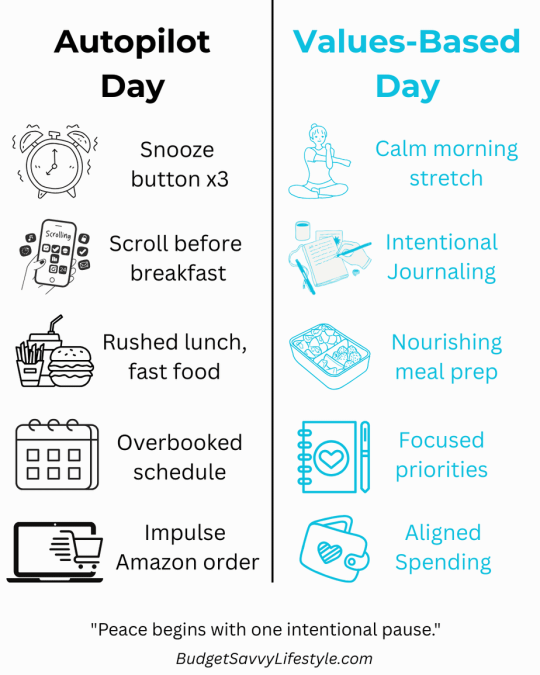
Living in alignment—or living a values-based life—means your actions, habits, and decisions reflect your personal values. You’re no longer just reacting to the chaos or chasing someone else’s version of success. Instead, you’re building a life that’s grounded in clarity and intention.

When you live in alignment:

  • Your time is spent on what energizes and fulfills you
  • Your money supports your true goals and priorities
  • Your habits move you toward the life you want
  • Your mindset feels grounded and empowered
  • Your life starts to feel like yours again

This doesn’t require perfection or having it all figured out. It simply requires awareness and tiny aligned choices—taken one day at a time.

The Problem with Autopilot Living

If you’ve ever caught yourself saying:

  • “I’m busy all day but feel like I got nothing meaningful done.”
  • “I want to save money but keep impulse spending.”
  • “I don’t even know what I want anymore… I’m just surviving.”

You’re not broken.
You’re just out of alignment.

Autopilot living is common, especially during seasons of overwhelm, transition, or even outward success. When you’re in it, your days are full—but your soul feels empty. Your schedule is packed—but your values are buried.

You may find yourself:

  • Drifting into habits that don’t serve you
  • Feeling disconnected from your purpose
  • Spending time and money on things that don’t actually matter to you
  • Saying “yes” to everything and everyone—except yourself

The good news? Alignment is always possible. It starts with getting clear.

Values-based living vs living on autopilot inforgraphic

Step One: Clarify What Matters Most

Before you can create a life that reflects your values, you have to define what those values are. Clarity gives you a compass. Without it, it’s easy to get swept up in what everyone else is doing.

Try these 3 simple exercises:

 
1. Name your top 3 values

Ask yourself: What matters most to me right now?
Write down three words that reflect your values today.
Examples: Peace. Flexibility. Family. Purpose. Simplicity. Creativity. Health.

This list will change over time—but naming it today gives you a starting point.

2. Describe your dream day

Imagine a day that feels calm, fulfilling, and energizing.
What would you do? What wouldn’t you do?
How would your morning feel? Your evening? What would be different from today?

This vision helps you uncover your values in action.

3. Pinpoint one area that feels “off”

Where do you feel guilt, resistance, stress, or disconnection?
That area is probably misaligned. Maybe you’re overspending, overcommitting, or just running on empty. That’s where your next small shift can begin.

Step 2: Audit Your Current Life

Awareness is the first step to change—and it starts with an honest look at how you’re living now.

Before you can create a life that reflects your values, you need to understand where you’re currently out of alignment. This step isn’t about judgment—it’s about curiosity. You’re simply gathering clues about what’s working and what’s not.

Use this audit to explore how your time, money, energy, and routines are being spent—and whether those choices reflect what matters most to you.


🗓️ Review Your Weekly Calendar

Look at how you spent your time over the past 7 days. Where did your hours go?

Ask yourself:

  • What filled my days—work, errands, scrolling, caregiving?

  • Did I schedule time for things that restore me?

  • Which activities energized me—and which ones drained me?

  • Am I overcommitted in ways that pull me away from my values?

Highlight what felt aligned (a peaceful morning, a family dinner, a walk in nature). Circle what felt misaligned (meetings that could’ve been emails, constant multitasking, zero alone time).

This reveals where your time and values do or don’t match up.


💸 Track Your Spending for 7 Days

Money is one of the clearest indicators of what you’re prioritizing—consciously or not.

Spend a week writing down everything you spend. Then reflect:

  • Which purchases felt aligned with my values (e.g. nourishing groceries, a donation, a tool that made life easier)?

  • Which felt impulsive, wasteful, or emotionally driven?

  • Are there patterns in how I spend when I’m stressed, bored, or overwhelmed?

You don’t need to restrict—just observe. This will help you create a budget that reflects what really matters to you.


🔁 Observe Your Energy + Daily Routines

Your body and mood are powerful feedback tools.

Ask yourself:

  • When do I feel most like myself?

  • Which parts of my day feel rushed, tense, or chaotic?

  • What habits ground me—and what ones derail me?

  • Do I wake up with intention—or immediately react to the day?

Take note of:

  • Sleep routines

  • Screen time habits

  • How often you move your body

  • What you eat and drink

  • Your mindset and self-talk

These small things shape the way you feel—and often signal where you’re out of sync with your deeper needs.


📝 Bonus: Check Your Commitments

List out your current obligations—work, family, volunteering, side projects, social plans.

For each one, ask:

  • Does this support my values?

  • Do I genuinely want to do this—or am I people-pleasing?

  • Is this the right season for this commitment?

It’s okay to lovingly release things that no longer fit your life.


💡 Pro Tip: Don’t Try to Change It All Right Away

You’re not auditing your life so you can overhaul it tomorrow.
You’re doing this so you can take aligned action—intentionally and one step at a time.

This awareness helps you identify one small shift to make in Step 3.

Step Three: Make One Small Shift

Trying to overhaul your whole life overnight is overwhelming and unsustainable. That’s not what alignment is about.

Living a values-based life happens through micro-moves.

Here are small, aligned shifts you could try:

Time

  • Protect your mornings for a quiet routine
  • Add white space to your calendar
  • Create a weekly rhythm to bring stability

Money

  • Track your spending and notice what feels aligned
  • Cut expenses that don’t bring value
  • Save for things that actually light you up

Mindset

  • Replace all-or-nothing thinking with “progress over perfection”
  • Reframe limiting beliefs (like “I never follow through”)
  • Practice gratitude for what’s already aligned

Habits

  • Add a 5-minute intentional ritual to your day
  • Stack a habit onto something you already do (habit stacking!)
  • Choose one new action that reflects your values—and repeat it

These shifts are simple. But over time, they create a life that feels aligned—not just looks productive.

Step 4: Create Supportive Systems

Once you’re clear on what matters, it’s time to build structure around it.

Creating a values-based life isn’t about discipline—it’s about design. Systems help you protect what’s important, reduce decision fatigue, and stay aligned when life gets full or messy (because it will!).

Supportive systems are rhythms, routines, and tools that take your values from ideas to action. They make your days feel lighter and more intentional—not more rigid or demanding.

Think of them as anchors that support your aligned life behind the scenes.


📅 Weekly Planning That Reflects Your Values

Instead of starting your week with a to-do list, start with your top 3 values. Ask:

  • What matters most this week?

  • How can I protect time for that—on purpose?

  • Where do I need to say no so I can say yes to what fills me?

Then build your schedule around what matters—not just what’s urgent. For example:

  • If family is a core value, block off unhurried dinner times.

  • If growth is a priority, schedule reading or course time.

  • If peace is what you need, leave margin for rest or creative flow.

💡 Tip: Create a weekly reset ritual (like on Sundays) to reflect, plan, and realign. This keeps your values front and center.


💰 Budget Systems That Reflect Your Real Goals

Money stress often stems from misalignment—not just lack.

When your budget reflects your values, you feel more in control and less restricted. Try this:

  • Label your spending categories by goal or feeling (e.g. Joyful Giving, Health & Nourishment, Peaceful Home)

  • Track your spending not just by amount, but by alignment

  • Build a habit of checking in weekly with your money—not just monthly

This turns budgeting into a tool of empowerment instead of anxiety. You’re telling your money where to go—based on what matters most.


🍳 Routines That Reduce Stress (and Reflect Your Season)

Stress doesn’t always come from doing too much—it often comes from deciding too much.
Routines minimize decisions while maximizing peace and energy.

Here are a few value-aligned routines to try:

  • Morning routine that sets the tone for your day (e.g. stretch, journal, read a quote, set intentions)

  • Meal planning system that saves money and supports your health goals (e.g. theme nights or ingredient prep)

  • Evening wind-down ritual that helps you reconnect and reflect (e.g. tea, gratitude list, screen-free hour)

  • Home care rhythm that keeps your space supportive (e.g. a 10-minute reset each night or a weekly “house cleaning power hour”)

The key is not complexity—it’s consistency. Start with one simple habit, and let it become a supportive rhythm.


🔄 Automate or Simplify What Drains You

Alignment isn’t just about adding more of the good—it’s also about removing the things that drain your energy and decision-making power.

Ask:

  • What can I automate? (e.g. bill payments, grocery list templates, recurring routines)

  • What can I simplify? (e.g. meal planning, wardrobe, inbox filters)

  • What can I delegate or release?

Even small tweaks (like batching errands or creating a default grocery list) can free up mental space for the things that matter most.


💡 System-Building Doesn’t Have to Be Perfect

Don’t wait until you’ve found the perfect planner, ideal routine, or best app.

Start with a simple question:
“What system would make this area of my life easier—and more aligned with my values?”

Then try one small experiment. Build slowly. Tweak often. Let your systems support your season, not some fantasy version of your life.

Step 5: Revisit and Realign Regularly

Living a values-based life is a rhythm—not a one-time reset.

Alignment isn’t something you “set and forget.” It’s a living, breathing practice—one that shifts as your life, priorities, and seasons evolve. What felt aligned last year (or even last month) may not feel aligned today—and that’s okay.

That’s why making space to pause and reflect is essential. These intentional check-ins allow you to course-correct before burnout, realign when you feel off, and celebrate the small shifts you’re already making.


🗓️ Create a Monthly Alignment Check-In

Think of this as your personal reset ritual—a gentle time to reflect, adjust, and move forward with intention.

Here’s a simple framework you can use each month:


1. Reconnect with Your Values

Ask:

  • Do my top 3 values still feel true this month?

  • Have any new priorities or desires emerged?

  • Is my life structured around these values—or drifting from them?

Remember, your values might evolve over time. What matters is that you keep asking the question.


2. Review What’s Working (and What’s Not)

Look back at your routines, systems, habits, and choices.

Consider:

  • Where did I feel most like myself this month?

  • What drained me or pulled me out of alignment?

  • What patterns, commitments, or beliefs no longer serve me?

This reflection helps you gently release what’s no longer a fit—and keep what supports your well-being.


3. Celebrate Small Wins

Living with intention doesn’t mean perfection—it means awareness and progress. Acknowledge the aligned choices you did make:

  • Saying no to something that felt off

  • Starting a new habit that reflects your values

  • Protecting time for what you love

  • Being more mindful with your money

  • Pausing before reacting out of habit

Even the tiniest shift deserves celebration. These micro-moments of alignment compound over time.


4. Choose One Area to Realign

You don’t need to fix everything. Choose one focus for the upcoming month:

  • Do you want to feel more peace in your mornings?

  • More intention in how you spend money?

  • More presence in your relationships?

Pick a small, specific action—like a new boundary, a simplified routine, or a reflective journaling habit—that supports that intention.

💡 Keep it doable, gentle, and rooted in what matters most to you right now.


🌿 Bonus: Use Rituals to Anchor Your Realignment

Turn your check-ins into a calming ritual you look forward to:

  • Light a candle, make tea, or play soft music

  • Use a printable journal page or values check-in worksheet

  • Pair it with your monthly planning or Sunday reset routine

  • Reflect, release, and recommit—with self-compassion

✨ Alignment isn’t about perfection. It’s about presence.
Every time you realign—even a little—you’re building a life that reflects who you truly are.

Why It’s Worth It

When you live a values-based life, everything changes:

✨ You no longer feel like you’re constantly behind
✨ You spend your money more intentionally—without guilt
✨ You protect your energy, boundaries, and joy
✨ You make decisions with clarity and confidence
✨ You feel more like yourself, even in busy seasons

And most importantly—you stop waiting for the “perfect time” to live the life you want.
You start building it now, one intentional day at a time.

You Deserve a Life That Reflects What Matters

You don’t need to be more disciplined.
You don’t need another productivity hack.

You need a system that helps you live on purpose.
You need support that honors your season—not your to-do list.
You need space to remember what you truly want—and tools to act on it.

So start here:

✅ Name your values
✅ Dream up your ideal day
✅ Make one tiny shift

Because when your life reflects what matters most—you stop feeling like you’re running in circles…
And start living like the version of you you’re becoming.

What Is a Meal Planning Framework (And Why You Need One)

July 10, 2025

Why Meal Planning Often Fails (and What to Do Instead)

Have you ever set out with the best intentions to plan your meals—only to quit after a few weeks (or days)? It’s not because you’re lazy or disorganized. More often than not, meal planning fails because there’s no framework—no flexible, repeatable system to guide your decisions week after week.

Enter: the meal planning framework. If you’ve never heard of one, you’re not alone. But once you learn how it works, it’s a total game-changer.

In this post, we’ll break down what a meal planning framework is, how it helps reduce overwhelm and decision fatigue, and how to find the right one for your lifestyle. 

A table with meal planner and groceries

What Is a Meal Planning Framework?

Think of a meal planning framework like a blueprint for your weekly food routine. It’s not a strict menu or a one-size-fits-all plan—it’s a customizable structure that helps you plan meals in a way that supports your lifestyle, preferences, and schedule.

Instead of starting from scratch every week (which leads to burnout), your framework gives you:

  • Predictability
  • Simplicity
  • A sense of flow

It’s like having a go-to formula you can tweak week to week—without rethinking every detail.

Why You Need a Framework (Not Just a Meal Plan)

Here’s what happens when you don’t have a meal planning framework:

  • You overthink every meal.
  • You forget what worked last week.
  • You waste time deciding “what’s for dinner.”
  • You overspend on groceries (or run out of key ingredients).

A framework gives your planning process structure and stability—without being rigid or boring.


Top 3 Benefits of Using a Meal Planning Framework:

 
1.  Fewer Daily Decisions

With a framework in place, your brain doesn’t have to start from zero every time. You already have categories, themes, or templates to guide you.

2.  Smarter Grocery Habits

When you plan meals with a system, your grocery list becomes more consistent and efficient. You’ll waste less food, avoid impulse buys, and stick to your budget.

3.  More Consistency (Without the Burnout)

A good framework is repeatable and realistic. It adapts with your life, so you can stay on track even when things get busy or unpredictable.

Daily, Weekly, and Rotating Planning Styles: Which One Fits You?

Your meal planning framework depends on your planning personality and life season. Here are the three most common styles:

Daily Planning

Best for: Flexible eaters, singles, or people with changing schedules
Framework: Plan each morning or the night before based on what’s available
Pros: Lots of flexibility, uses up leftovers
Cons: More mental energy, last-minute grocery runs

Weekly Planning

Best for: Families, routines, people who like prep days
Framework: Plan 5–7 meals in advance every week, with a grocery run to match
Pros: Efficient, batch-friendly, predictable
Cons: Requires a dedicated planning session

Rotating Frameworks

Best for: Busy families, overwhelmed planners, or anyone who hates reinventing the wheel
Framework: Rotate between 2–4 pre-set meal plans (or themes) every month
Pros: Set it and forget it, great for budgeting
Cons: Can get repetitive if not refreshed regularly

Simple Meal Planning Framework Examples

You don’t need anything fancy or complicated to meal plan well. In fact, some of the most effective frameworks are also the simplest.

When you start with a basic structure, it becomes easier to stay consistent week after week—especially if you’re juggling a busy life, a budget, or picky eaters.

Here are three beginner-friendly frameworks you can use to simplify your meal planning right away:


1. The Theme Night Framework

A fun, family-friendly approach that brings rhythm to your week.

This method assigns a theme or food category to each day of the week. It removes the daily “what should we eat?” decision by narrowing your focus, and it’s perfect for families who like a little routine with a sprinkle of variety.

Example:

  • Monday – Meatless Meals (veggie stir-fry, lentil soup, pasta primavera)

  • Tuesday – Taco Tuesday (ground beef, fish tacos, black bean wraps)

  • Wednesday – Slow Cooker Night (chili, pulled chicken, stew)

  • Thursday – Pasta Night (spaghetti, baked ziti, Alfredo)

  • Friday – Pizza Night (homemade pizza, naan flatbreads, English muffin minis)

  • Saturday – Leftovers or Eat Out

  • Sunday – Roast or Family Dinner (whole chicken, roast veggies, comfort food)

Why It Works:

  • It builds in variety while still feeling predictable

  • Makes grocery list planning faster (you know what to buy for each theme)

  • Kids love the fun, repeatable rhythm

  • Easy to customize for dietary needs or preferences

Tip: Keep a go-to list of 3–5 meal ideas under each theme so you’re never starting from scratch.


 2. The Ingredient Framework

A mix-and-match method for maximum flexibility and minimal waste.

With this style, you build your meal plan around a core set of versatile ingredients—typically 2–3 proteins, grains, and vegetables. You can then mix and match them in different ways throughout the week to create balanced, simple meals without much extra planning.

Example Week:

  • Proteins: Chicken thighs, lentils, eggs

  • Grains: Brown rice, quinoa, tortillas

  • Veggies: Broccoli, spinach, bell peppers

Meal Ideas:

  • Chicken stir fry with rice and broccoli

  • Lentil tacos with sautéed peppers and tortillas

  • Veggie-packed frittata with spinach and eggs

  • Quinoa bowl with roasted chicken and veggies

  • Wraps using leftovers and extra greens

Why It Works:

  • Reduces food waste by using ingredients multiple times

  • Great for improvisers and intuitive cooks

  • Perfect if you like variety without reinventing the wheel every day

  • Budget-friendly (shop sales and plan around what’s in your pantry)

Tip: Prep ingredients once (like a batch of roasted veggies or cooked quinoa) and use them in different meals all week.


 3. The 4-Week Rotating Plan

A “set it and forget it” option for busy seasons or those who crave consistency.

This framework involves creating four weekly meal plans that rotate each month. Each week has its own set of meals, grocery list, and even prep plan. You reuse these four plans on a monthly cycle, updating them seasonally to keep things fresh.

How It Works:

  • Week 1: Theme night plan with tacos, crockpot meals, pizza night

  • Week 2: More global flavors (stir fry, curry, pasta)

  • Week 3: Sheet pan dinners, salads, sandwiches

  • Week 4: Comfort food + leftover reinventions

Once built, this system becomes mostly automatic. You just pull out that week’s plan, shop from its grocery list, and roll with it.

Why It Works:

  • Saves time—no new plan required every week

  • Reduces decision fatigue to nearly zero

  • Encourages rhythm and routine in family meals

  • Helps with budgeting and batch shopping (especially if you reuse ingredients across weeks)

 Tip: Refresh your 4-week rotation quarterly to add seasonal ingredients or new recipes you’ve discovered.

How to Build a Framework That Works for You

You don’t have to commit to one “perfect” system. In fact, the best framework is one that:

  • Feels intuitive
  • Matches your schedule
  • Uses foods your family actually eats
  • Makes planning easier, not harder

Final Thoughts

Each of these frameworks offers a different level of structure and flexibility. The key is to pick one that matches your lifestyle, experiment with it for a few weeks, and adjust as needed. You can even combine them—like using a 4-week rotation made up of themed nights, or combining the ingredient method with weekly planning.

Meal planning doesn’t have to feel like a chore. With a framework in place, you’ll save time, money, and mental energy—while feeding your family meals that work for your life.

It’s not about perfection. It’s about having a system you can return to every single week.

  • Page 1
  • Page 2
  • Go to Next Page »

Primary Sidebar

Welcome!


Hi, I’m Rebecca—a blogger and budget-savvy wife and mom who loves helping women live intentionally without overspending.
Read more →

Blog Mission Statement

Helping women create the life of their dreams—on purpose, on budget, and one simple step at a time.

Through intentional habits, budget-savvy choices, and doable daily systems, I’ll help you take control of your time, money, and mindset. Let’s make real change feel totally possible.

Recent Posts

  • The Spending Audit: How to Find & Cut Wasteful Expenses
  • How to Live a Values-Based Life: 5 Steps to Realign Your Time, Money, and Mindset
  • What Is a Meal Planning Framework (And Why You Need One)
  • From Dreaming to Doing: Your Roadmap to Stress-Free Travel Planning
  • Why You Need a Sunday Reset Routine (& What Happens Without One)
  • The Difference Between Cheap and Frugal (And Why It Matters)

This website is a participant in the Amazon Services LLC Associates Program, an affiliate advertising program
designed to provide a means for sites to earn advertising fees by advertising and linking to Amazon.com

Footer

Tags

$6 dinners $8 dinners 5 ingredient recipes Aldi thanksgiving dinner align your spending budget leaks budget lifestyle cheap Aldi dinners clarity and purpose crescent roll recipes Disney World planning dollar tree christmas dream trip planning easy aldi dinners frozen meatball recipes grocery planning home systems how to live on a budget intentional living intentional spending lifestyle design live in alignment meal planning on a budget meal planning systems minimalist budgeting money mindset productivity tips reset routine routines and rhythms save on produce self-awareness spending habits sunday reset time management travel checklist travel goal setting travel on a budget trim your budget values-based spending weekly meal plan hacks weekly meal planning weekly planning weekly routine

Categories

  • Aldi Holiday Meal Planning
  • Aldi Reviews
  • Aligned Living
  • Fitness
  • Food
  • Gift Guides
  • Healthy Eating
  • Intentional Travel Planning
  • Lifestyle
  • Meal Planning
  • Meal Planning
  • Meal Planning Frameworks
  • Money and Budgeting
  • Parenting Teens
  • Recipes
  • Spending Money Intentionally
  • Start Here
  • Time and Routines
  • Travel
  • Uncategorized
  • Well Being

Menu

  • Contact
  • Disclaimer
  • Privacy Policy
  • Terms and Conditions

Copyright © 2026 · HelloPeach on Genesis Framework · WordPress · Log in